Epoxy-Coated Steel
A practical fabricated-metal option with a protective coating inside and out. Well suited to many conventional custom applications where shape, size, or connection placement drives the project.
Versatile metal optionBuilt around your project
Custom grease traps and interceptors engineered around your dimensions, connections, material requirements, and operating needs.


Why go custom?
A custom interceptor gives your project team more control when a standard size, shape, inlet, outlet, or material is not workable.
We help turn your field dimensions and operating requirements into a purpose-built unit. Custom fabrication can solve tight footprints, unusual pipe alignments, retrofit conditions, high-use applications, and specialized facilities.
Material choices
Material selection depends on corrosion exposure, operating conditions, available space, budget, and the requirements of the approving authority.
A practical fabricated-metal option with a protective coating inside and out. Well suited to many conventional custom applications where shape, size, or connection placement drives the project.
Versatile metal optionA premium, corrosion-resistant choice for demanding environments, exposed installations, and facilities that prioritize durability and an easy-to-clean metal surface.
Premium durabilityA non-corroding plastic option that can reduce weight and support specialized shapes. Material and structural requirements are reviewed for the specific installation.
Corrosion-resistant plastic
Replacement planning
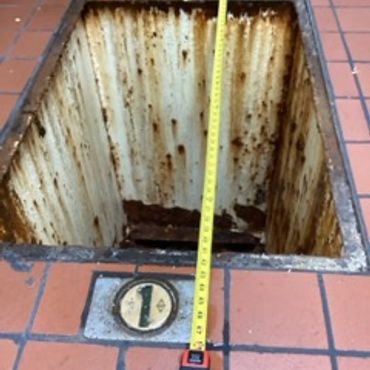
Advanced corrosion can weaken walls, lids, baffles, and connection points. It can also make cleaning more difficult and may lead to leakage, odors, failed inspections, or an unexpected shutdown.
If an older trap shows heavy scaling, perforation, soft metal, a failing lid, or recurring leaks, document the condition and have the unit evaluated. We can review the existing footprint for a custom replacement—or explore whether a fitted drop-in liner is appropriate.
Send Us the Project DetailsFrom problem to plan
Start with what you know. Photos, a marked-up sketch, maximum dimensions, or existing plans can help us understand the application.
Tell us whether this is a new build, replacement, retrofit, or liner application.
Provide dimensions, capacity or flow needs, pipe sizes, connection locations, and material preference.
Our team reviews the information, identifies open questions, and prepares the proposed configuration and quote.
After project details are confirmed and approved, the custom unit moves into fabrication.

Beyond the interceptor
Through our relationship with Ryan Herco Flow Solutions, Drain-Net can also help source plastic piping systems, valves, fittings, tanks, measurement equipment, and related fluid-handling components.
This is especially useful for industrial or specialized projects where the interceptor is only one part of a broader waste-management or process-flow system.
Explore Ryan Herco product capabilitiesPlanning answers
Custom projects vary. These answers provide a useful starting point before the detailed review.
A custom unit may be appropriate when the available footprint, connection locations, required capacity, chosen material, or replacement conditions cannot be addressed by a standard model.
Send the project city and state, maximum available dimensions, desired capacity or flow rate, pipe sizes, connection locations, material preference, timing, photos, and any plans or specifications you have.
Often, yes. We can review photographs, measurements, drawings, connection locations, and the original specifications when available. The replacement still needs to satisfy current project and local approval requirements.
We can help develop the product around your stated requirements, but the project owner, engineer, installer, and local authority having jurisdiction are responsible for confirming the required type, sizing, approvals, and installation.
No. A liner is a project-specific option. The existing structure, dimensions, connections, access, service conditions, and local approval requirements must be reviewed before determining whether a liner is suitable.
Ready to start?